Beestige Tijdreizigers
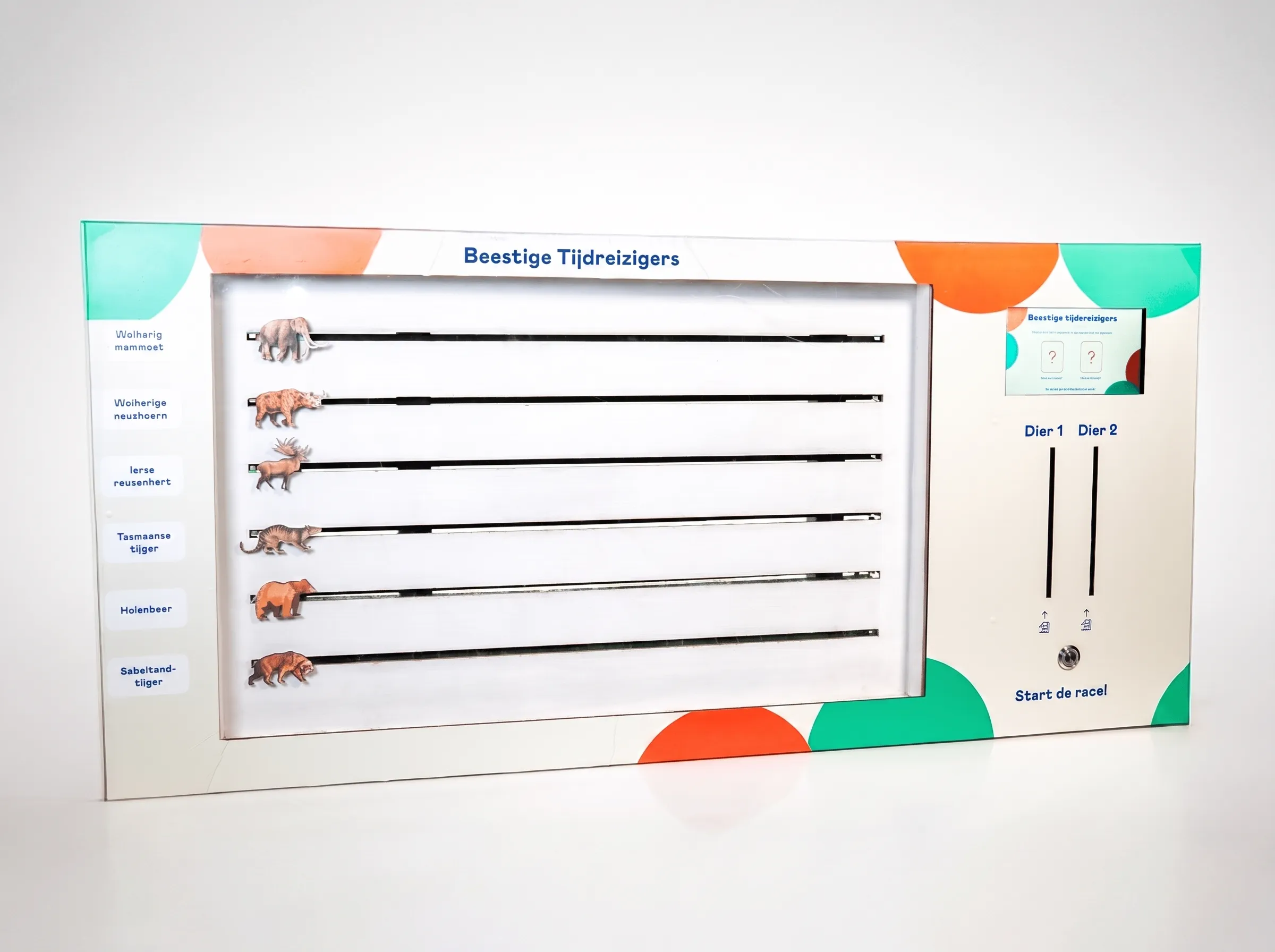
An interactive installation for Huis van Kina where children race prehistoric animals against each other at a scale matching their real-world speeds.
Period
October 2025 - January 2026My Roles
Used Technologies
Project documentation
Context
Beestige Tijdreizigers is an interactive installation we developed for Huis van Kina in Ghent. The installation is aimed at children between six and twelve years old and introduces them to extinct prehistoric animals in a playful way. Visitors choose two animals, such as the mammoth or the saber-toothed tiger, and insert their corresponding information card into the installation. The chosen animals then race against each other at a scale matching their real-world speeds, letting children discover in a visual and intuitive way how fast these animals moved.
We built this project as a team of four: Mees Akveld, Emie Van de Veire, Simon Van Tomme and myself. Within the team I primarily took on the role of technical lead and problem solver, focusing on the technical and hands-on side of the installation.
Contribution
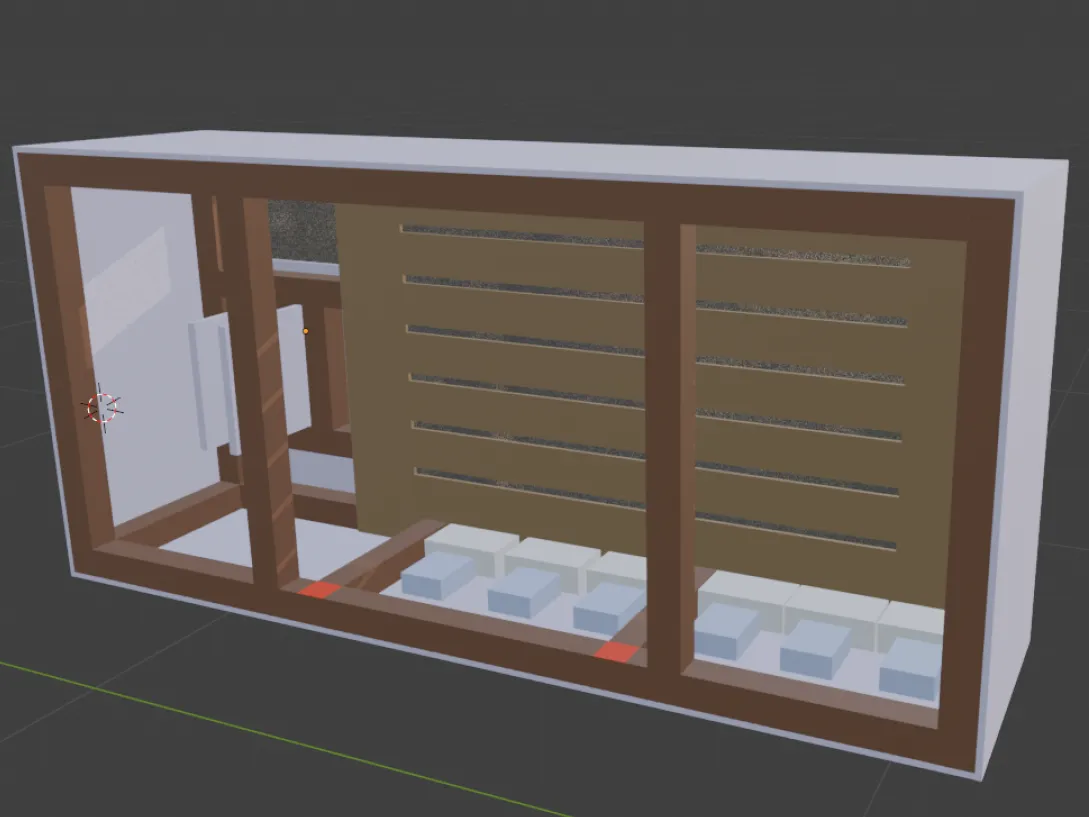
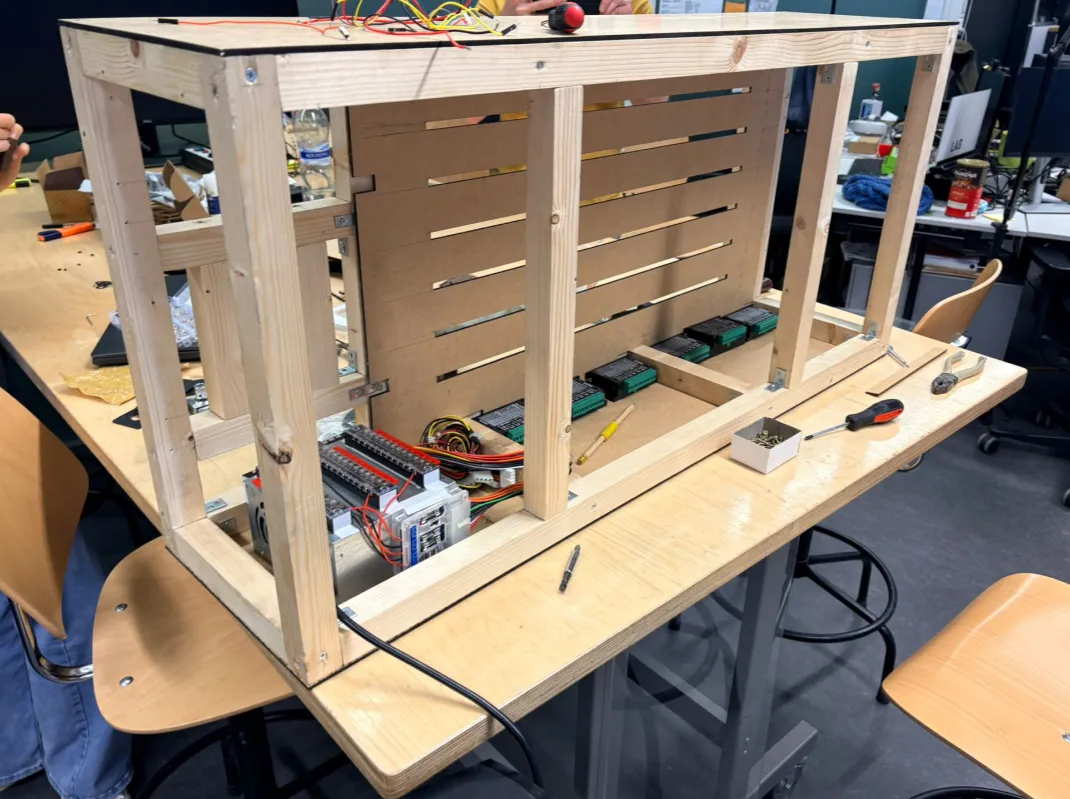
My focus was on the full housing and the mechanical and electronic workings of the installation. I first designed the entire frame in Blender, taking into account the mounting of the mechanics, the placement of the electronics, the wall attachment and the finishing with MDF panels. Based on that design I created the SVG files for laser cutting and assembled the housing myself.
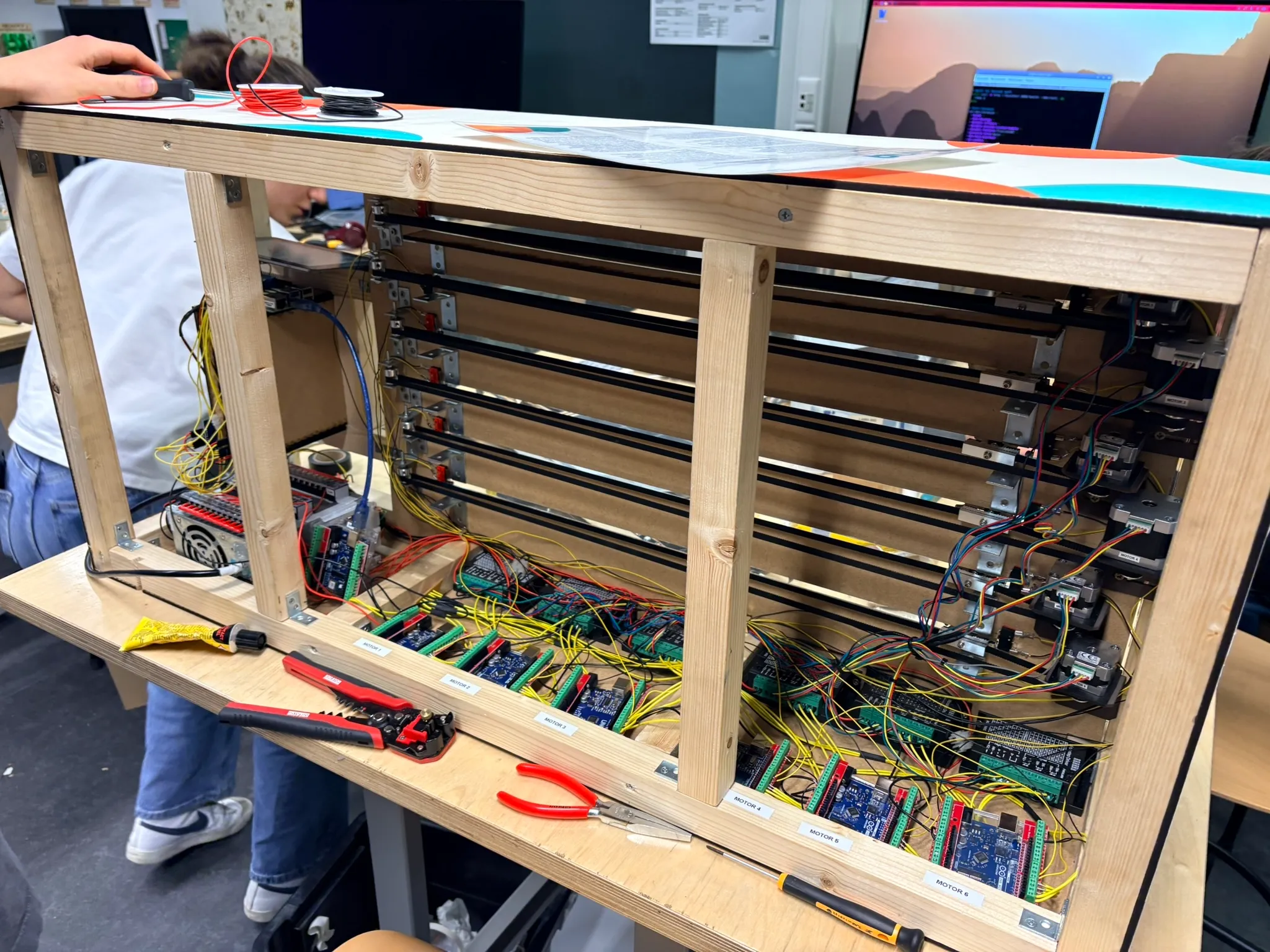
I also worked out the full mechanical system for the rails: the animals move via timing belts with sprockets at each end, and are fixed to the belt using a belt clamp and bolt. I designed almost all of the 3D models used, such as the motor mounts and the fastening systems. On the software side I wrote the Arduino code that controls the motor system, including configurable speed and acceleration, the logic for the start and end switches, and the automatic reset of the motors on startup.
Challenge
This project came with several challenges, both mechanical and technical:
- Driving six stepper motors simultaneously and reliably
- Designing a mechanical system for the rails that is durable and easy to maintain
- Converting the real-world speeds of the animals to a correct scale within the capabilities of the motors
For the motor control we chose to drive each motor with its own dedicated Arduino. This was the most robust solution we could come up with to run all motors simultaneously and reliably.
The mechanical system for the rails required the most thought. After several iterations I landed on a system using timing belts with sprockets at each end, with the animals fixed to the belt via a belt clamp. This solution proved both reliable and easy to maintain.
To correctly scale the animals' speeds, we worked together with Huis van Kina to find reliable information about their real-world speeds, and scaled those within the capabilities of the motors.
Result
The installation works as intended and is still being used at open days at Arteveldehogeschool. Children, our target audience, loved choosing animals and racing them against each other. Beestige Tijdreizigers was the first installation I ever built. The project showed me that designing and building mechanical and electronic systems comes naturally to me, and gave me a first sense of the direction I want to develop in.